Securing SMTP Transport with DNSSEC, DANE, and TLSA
1. The problem these protocols solve
SMTP, the mail transport protocol, has no security built in at the protocol level (RFC 5321). One extension lets it encrypt the transport:
- STARTTLS (RFC 3207): opportunistic TLS negotiation after the connection starts in the clear.
- The problem: STARTTLS is optional and, by default, unauthenticated. An attacker in a man-in-the-middle position can:
- strip the
STARTTLSkeyword from the server’s response (a downgrade attack, known as STRIPTLS); - present a self-signed or spoofed certificate, which the client often accepts anyway, since SMTP doesn’t normally validate the certificate name under opportunistic TLS.
- strip the
DANE (DNS-based Authentication of Named Entities, RFC 6698) solves exactly this problem: it lets a domain publish, in the DNS itself, the fingerprint of the TLS certificate its servers must present — making that information verifiable independently of traditional certificate authorities (CAs). But for that DNS announcement to be trustworthy, it must itself be protected against tampering — that’s the role of DNSSEC.
2. DNSSEC: authenticating DNS data
2.1 Principle
Plain DNS offers no authenticity guarantee: a response can be forged via spoofing, cache poisoning, or an on-path attack. DNSSEC (RFC 4033, 4034, 4035) adds a layer of asymmetric cryptographic signatures on top of the DNS hierarchy, without changing the transport protocol itself.
Each signed zone publishes:
| Record | Role |
|---|---|
| DNSKEY | The zone’s public key (KSK, Key Signing Key, and ZSK, Zone Signing Key) |
| RRSIG | Signature of a record set (RRset) by the corresponding private key |
| DS (Delegation Signer) | Fingerprint of the child zone’s public key, published in the parent zone — the link in the chain of trust |
| NSEC / NSEC3 | Authenticated proof that a record does not exist |
2.2 The chain of trust
Trust flows down from the root zone (whose key is embedded in resolvers, managed by IANA) to the final domain, with each zone signing the public key of the zone delegated immediately below it.
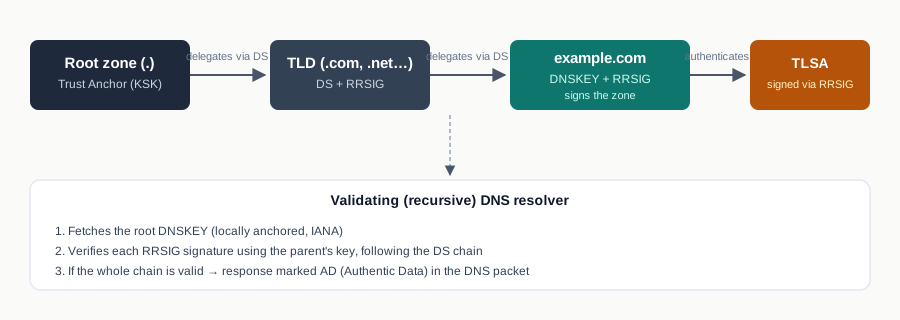
Concretely, a validating DNS resolver:
- holds the root’s trust anchor;
- follows the delegation
. → .com → example.com, checking at each step that the DS published by the parent matches the child’s key (DNSKEY), and that every RRset is correctly signed (RRSIG); - if the whole chain validates, sets the AD (Authentic Data) bit in the DNS response header.
Without that AD bit, a record — including a TLSA record — must not be treated as trustworthy for DANE purposes.
2.3 What DNSSEC does not do
DNSSEC guarantees the authenticity and integrity of DNS data (it really comes from the legitimate zone owner and hasn’t been altered), but it does not encrypt DNS queries/responses (no confidentiality — that’s the role of DoT/DoH, out of scope here).
3. TLSA: publishing a certificate fingerprint in the DNS
3.1 Record name and structure
A TLSA record (RFC 6698) is published under a name built as:
_<port>._<protocol>.<hostname>For a mail server mail.example.com listening for SMTP on port 25:
_25._tcp.mail.example.com. IN TLSA 3 1 1 <SHA-256 fingerprint of the public key>3.2 The four TLSA fields
| Field | Possible values | Meaning |
|---|---|---|
| Usage (0–3) | 0 PKIX-TA, 1 PKIX-EE, 2 DANE-TA, 3 DANE-EE | What’s being constrained: a specific CA, or the end-entity certificate directly, with or without classic PKIX validation on top |
| Selector (0–1) | 0 = full certificate, 1 = public key (SubjectPublicKeyInfo) only | Which part of the certificate is hashed |
| Matching type (0–2) | 0 = raw data, 1 = SHA-256, 2 = SHA-512 | Hashing algorithm used |
| Association data | Hex-encoded fingerprint | The value to compare against |
For email, the combination recommended by RFC 7672 is 3 1 1 (DANE-EE, public key, SHA-256): the presented certificate must match exactly, independent of any certificate authority — which even allows self-signed certificates, as long as the DNS fingerprint itself is trustworthy.
3.3 Client-side verification
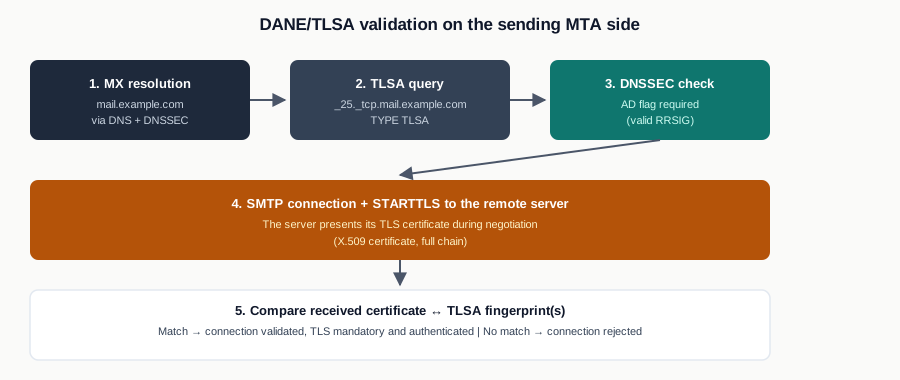
Before sending a message, the sending SMTP server (more precisely, its outbound MTA):
- resolves the recipient domain’s MX records;
- queries the DNS for the TLSA record matching
_25._tcp.<MX host>; - requires the response to be DNSSEC-validated (AD bit present) — without it, DANE doesn’t apply, and the connection falls back to plain opportunistic TLS, or even plaintext, depending on local policy;
- opens the SMTP connection, negotiates
STARTTLS, and retrieves the certificate presented by the remote server; - compares that certificate’s (or its public key’s) fingerprint against the TLSA records obtained;
- accepts the connection only on a match.
4. DANE applied to SMTP: RFC 7672
RFC 6698 defines DANE generically (usable for HTTPS, XMPP, and more). RFC 7672 (SMTP Security via Opportunistic DNS-Based Authentication of Named Entities) specifies how it applies to outbound email (MTA-to-MTA), notably:
- DANE for SMTP applies at the MX level, not the email domain: each MX record needs its own TLSA, since a domain can delegate mail to several different hosts.
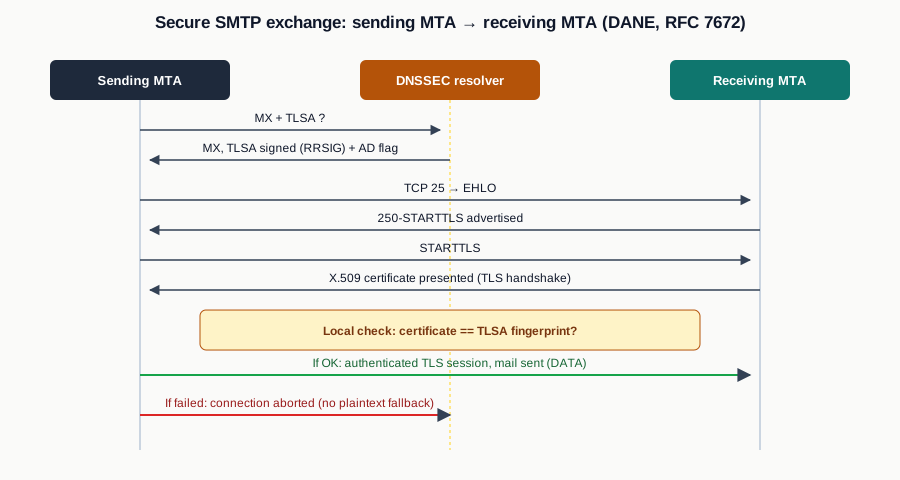
- The mode is called “opportunistic secure”: if no TLSA record exists (and that absence is itself proven by DNSSEC via NSEC/NSEC3), the client falls back to plain opportunistic STARTTLS without DANE. But if a TLSA record exists and validates under DNSSEC, DANE becomes mandatory: a certificate mismatch causes the connection to be refused, with no plaintext fallback.
- This directly fixes STARTTLS’s weakness: an attacker can no longer strip the TLS negotiation or substitute a fake certificate without it being detected, since the security policy (“TLS + this exact certificate, mandatory”) is anchored in signed DNS, out of the attacker’s reach on the network path.
Full MTA-to-MTA sequence
5. Security guarantees, summarized
| Threat | Without DANE | With DANE + DNSSEC |
|---|---|---|
STARTTLS stripped (STRIPTLS) | Mail goes out in the clear, no warning | Connection refused if TLSA requires TLS |
| Spoofed/self-signed certificate wrongly accepted | Accepted, since SMTP doesn’t validate the hostname by default | Rejected if the fingerprint doesn’t match |
| MX or TLSA record forged in transit | Possible via DNS poisoning | Prevented: DNSSEC signature is verified |
| Dependency on a third-party certificate authority | Yes (classic X.509 PKI) | Optional: usage 3 1 1 does away with CAs |
Limitations and prerequisites
- The recipient domain must sign its zone with DNSSEC and publish TLSA records consistent with the certificate actually presented (a certificate rotation forgotten in the TLSA record breaks mail delivery).
- The sending MTA must implement DANE (e.g. Postfix ≥ 2.11 with
smtp_dns_support_level = dnssec, Exim, some large providers’ relays). - DANE for SMTP only protects the MTA-to-MTA hop; end-to-end content encryption needs S/MIME or PGP, which is out of scope here.
- Don’t confuse it with MTA-STS (RFC 8461), an alternative/complement that relies on HTTPS and a policy published on an
mta-stssubdomain, without depending on DNSSEC — useful where DNSSEC isn’t deployed, but with a different trust model (TOFU, Trust On First Use, rather than DNS-anchored cryptographic trust).
6. Normative references (RFCs) and further reading
- RFC 3207 — SMTP Service Extension for Secure SMTP over Transport Layer Security (STARTTLS) — https://www.rfc-editor.org/rfc/rfc3207
- RFC 4033 — DNS Security Introduction and Requirements — https://www.rfc-editor.org/rfc/rfc4033
- RFC 4034 — Resource Records for the DNS Security Extensions — https://www.rfc-editor.org/rfc/rfc4034
- RFC 4035 — Protocol Modifications for the DNS Security Extensions — https://www.rfc-editor.org/rfc/rfc4035
- RFC 6698 — The DNS-Based Authentication of Named Entities (DANE) Transport Layer Security (TLS) Protocol: TLSA — https://www.rfc-editor.org/rfc/rfc6698
- RFC 7671 — The DANE Protocol: Updates and Operational Guidance — https://www.rfc-editor.org/rfc/rfc7671
- RFC 7672 — SMTP Security via Opportunistic DNS-Based Authentication of Named Entities (DANE) — https://www.rfc-editor.org/rfc/rfc7672
- RFC 8461 — SMTP MTA Strict Transport Security (MTA-STS) (complementary/alternative protocol) — https://www.rfc-editor.org/rfc/rfc8461
- RFC 5321 — Simple Mail Transfer Protocol — https://www.rfc-editor.org/rfc/rfc5321
Further documentation and tools
- ICANN, DNSSEC — What Is It and Why Is It Important? — https://www.icann.org/resources/pages/dnssec-what-is-it-why-important-2019-03-05-en
- Internet Society / Deploy360, practical DANE and DNSSEC guides — https://www.internetsociety.org/deploy360/dnssec/
- Online TLSA record tester — https://www.huque.com/bin/danecheck
- Postfix documentation on DANE support — http://www.postfix.org/TLS_README.html#client_tls_dane